Certified yoga teacher training in the Netherlands: an English-language guide
Many yoga teacher trainings in and around Amsterdam are taught in English, which makes the Netherlands an attractive place to train for expats and international students. But how do you compare programmes, and what does 'certified' actually mean? This guide explains the credentials, formats and questions to ask before you commit.
- "Yoga teacher" is not a protected title in the Netherlands; the quality of your training is what counts.
- The international baseline is a 200-hour training. A further 300 hours brings you to 500 hours.
- Yoga Alliance is a US-based international registry. Schools register as RYS; graduates can register as RYT.
- Compare trainers, teaching practice and support after graduation, not just the certificate.
What does "certified" mean in the Netherlands?
There is no government licence for yoga teachers in the Netherlands. Anyone may call themselves a yoga teacher. In practice, studios, gyms and insurers almost always ask for a completed training. Most English-language programmes in the Amsterdam area follow the standards of Yoga Alliance, an international registry used as a reference worldwide. Some Dutch-language programmes are longer, multi-year courses affiliated with Dutch professional associations.
So when a school says "certified", ask: certified by whom, and to what standard? A Yoga Alliance-registered school (RYS) has submitted its curriculum to the registry. That is a useful baseline, but it does not guarantee that every training is excellent. You still need to look at the people and the programme.
Yoga Alliance credentials explained
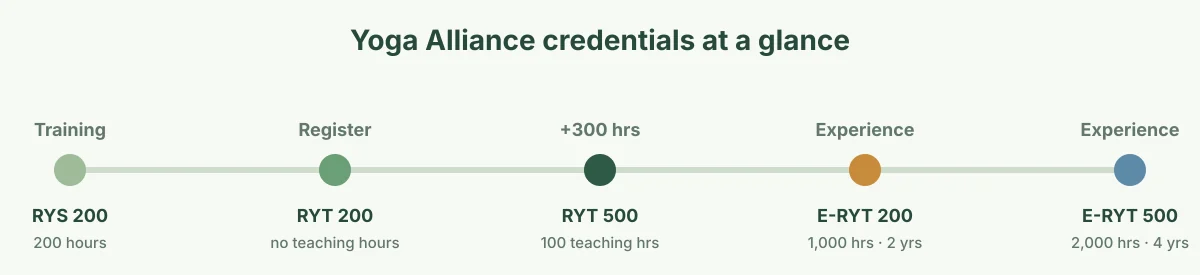
- RYS 200 / 300 / 500: a Registered Yoga School offering a training of that length.
- RYT 200: you completed a 200-hour training at one RYS 200 and registered. No teaching hours are required.
- RYT 500: 500 training hours in total (one 500-hour programme, or 200 + 300) plus at least 100 hours of teaching after your training.
- E-RYT 200: at least 1,000 teaching hours over a minimum of two years after your 200-hour training.
- E-RYT 500: at least 2,000 teaching hours over a minimum of four years. These teachers can lead trainings.
Since 2020, a 200-hour training follows a core curriculum with minimum hours: 75 hours of techniques, training and practice; 30 hours of anatomy and physiology; 30 hours of yoga humanities (history, philosophy, ethics); and 50 hours of professional essentials (teaching methodology, practicum and the business of yoga). The remaining hours are distributed by the school within those categories.
Formats: intensive, weekends or hybrid
| Format | Typical length | Good for | Watch out for |
|---|---|---|---|
| Intensive | 3–4 weeks full time | Full immersion, fast completion | Little time to integrate; physically demanding |
| Weekend modules | 6–12 months | Combining with work; practising between modules | Requires commitment over a long period |
| Hybrid / online | Varies | Flexibility, theory at your own pace | Check the number of live, in-person hours and feedback |
If you live and work in Amsterdam, weekend formats are popular because you can keep your job. If you are travelling to the Netherlands for a training, check whether you need a visa for the length of your stay and budget for accommodation, which can be expensive in and around Amsterdam.
How to compare trainings
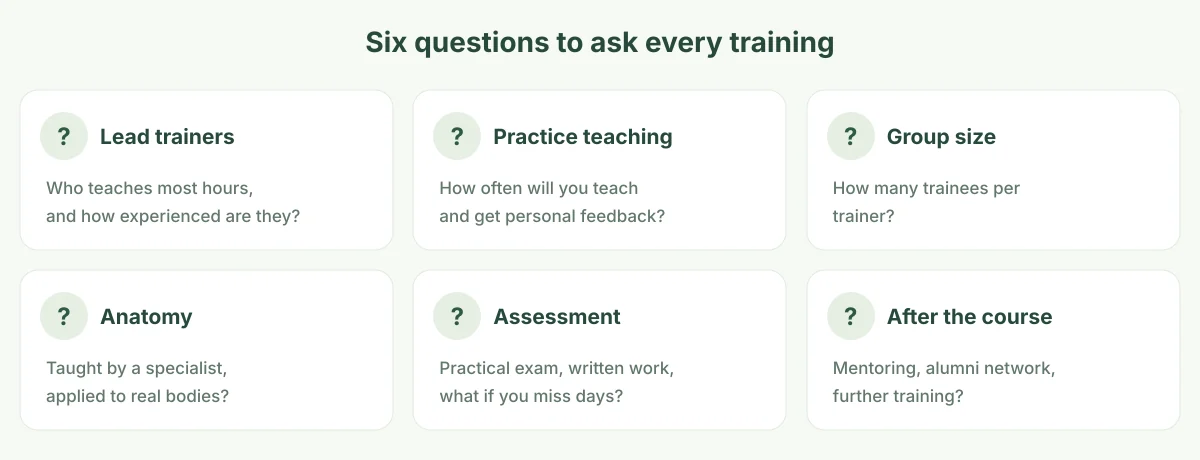
- Take a class with the lead trainers first. You will spend 200 hours with them. Make sure you connect with their teaching.
- Ask for the schedule and the hours per subject. How much time goes to your own practice, theory and actual teaching?
- Check the registration yourself. Look the school up in the Yoga Alliance directory or the register of the association it claims.
- Clarify what's included. Manual, books, exams, registration fees, make-up sessions, mentoring.
- Talk to graduates. Ask if they teach now and how prepared they felt.
- Consider the style. Hatha, vinyasa, yin, ashtanga: does it match how you want to teach? Some trainings cover several styles.
- Look at language. If you want to teach in Dutch studios later, it helps if part of the training also prepares you to cue in Dutch.
A good teacher matters as much as the curriculum. Our Dutch checklist explains how to recognise a good yoga teacher (in Dutch), and for a first look at the different styles you can read the overview of yoga styles (Dutch).
Are you ready?
Most trainings ask for one to two years of regular practice. You don't need to do advanced poses. Curiosity, commitment and an open mind matter more. Many participants join not to teach, but to deepen their own practice, and that is a perfectly good reason too.
Prefer Dutch? Read our Dutch guide to choosing a yogadocentenopleiding. Interested in a specialisation? See our (Dutch) guide to yin yoga teacher trainings.
Frequently asked questions
Do I need a certificate to teach yoga in the Netherlands?
Legally, no: yoga teaching is not a protected profession. In practice, studios, gyms and insurers expect a completed training, usually at least 200 hours.
Is Yoga Alliance recognised in the Netherlands?
Yoga Alliance is not a government body, but its credentials are widely used and understood by studios in the Netherlands and abroad.
Can I do a 200-hour training in English in Amsterdam?
Yes. Many schools in and around Amsterdam teach their trainings in English, partly because of the large international community.
How long does a 200-hour training take?
Three to four weeks as an intensive, or six to twelve months in weekend modules.
What is the difference between RYT 200 and RYT 500?
RYT 200 requires a 200-hour training. RYT 500 requires 500 training hours in total plus at least 100 hours of teaching experience.
This guide is general information and does not replace guidance from a qualified teacher, doctor or physiotherapist.