Kids yoga for ages 4–7: animal poses, breathing games and a ready-made session
Little children don't need perfect poses. They need play, movement, stories and a calm moment at the end. Yoga gives them all of that. This guide shows you ten animal poses, five breathing games and a complete 15-minute session you can do at home or in a classroom.
- For ages 4–7, keep sessions to 15–30 minutes and switch activity every few minutes.
- Name poses after animals and nature, add sounds and turn them into a story.
- Always include a breathing game and a short relaxation at the end.
- Focus on fun and safety, not on "correct" alignment. Never push a child into a stretch.
Why yoga is great for little kids
Between four and seven, children are learning to control their bodies, follow instructions, take turns and handle big feelings. Yoga touches all of these. Balancing like a tree builds coordination. Roaring like a lion releases energy. Lying still like a sleepy mouse teaches that calm can feel good too.
Research on yoga for young children is still limited, but studies and teachers' experience point in the same direction: playful yoga can support body awareness, concentration and self-regulation. Above all, it gives children a positive, non-competitive way to move. There is no winning in yoga, and that is a relief for many kids.
How to keep it playful
- Tell a story. "We're going on a jungle adventure!" turns a sequence of poses into a journey: walk like an elephant, climb a tree, meet a snake, hide like a mouse.
- Add sounds and movement. Hiss in snake, bark in dog, flap in butterfly. Sounds help children breathe out fully, too.
- Keep it short. Hold poses for three to five breaths at most, or for a short song line. Then move on.
- Let them lead. Ask "Who can show me a new animal?" Children love inventing poses and teaching them to the group.
- Praise effort, not shape. "Wow, your tree is so steady!" works better than correcting a foot position.
- Use simple props. A beanbag on the head, a scarf to wave, a soft toy to breathe with.
10 animal and nature poses
1. Mountain
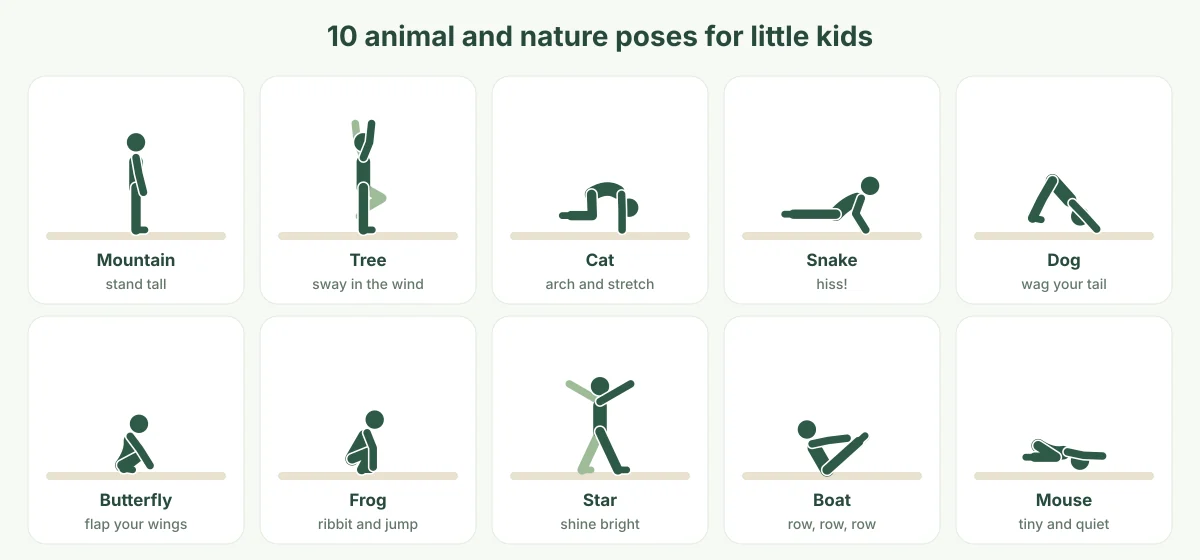
Stand tall with feet together, arms by your sides. "Be a strong mountain. Can the wind push you over?" A great starting and resting pose.
2. Tree
Stand on one leg and place the other foot on the ankle or calf, never on the knee. Arms up like branches. Sway gently in the wind. Holding a wall or a friend's hand is fine.
3. Cat (and cow)
On hands and knees, round the back like a scared cat ("hhhhh!"), then let the belly drop and look up like a cow ("moooo!").
4. Snake
Lie on the tummy, hands under the shoulders, lift the chest a little and hiss. Keep elbows bent and hips on the floor.
5. Dog
From hands and knees, push the bottom up high. Wag the "tail", lift one leg for a three-legged dog, and bark.
6. Butterfly
Sit with the soles of the feet together and flap the knees like wings. "Where is your butterfly flying today?"
7. Frog
Squat with knees wide and hands on the floor between the feet. Say "ribbit" and jump up, landing softly back in the frog.
8. Star
Stand with feet wide and arms stretched out to the sides. Fingers spread wide: "Shine as bright as you can!"
9. Boat
Sit, lean back a little and lift the feet, holding the knees if needed. Row the boat and sing a song. Hard work for the tummy muscles!
10. Mouse
Child's pose: knees on the floor, bottom on the heels, forehead down. Tiny and quiet like a mouse. Perfect for calming down between active poses.
Breathing games
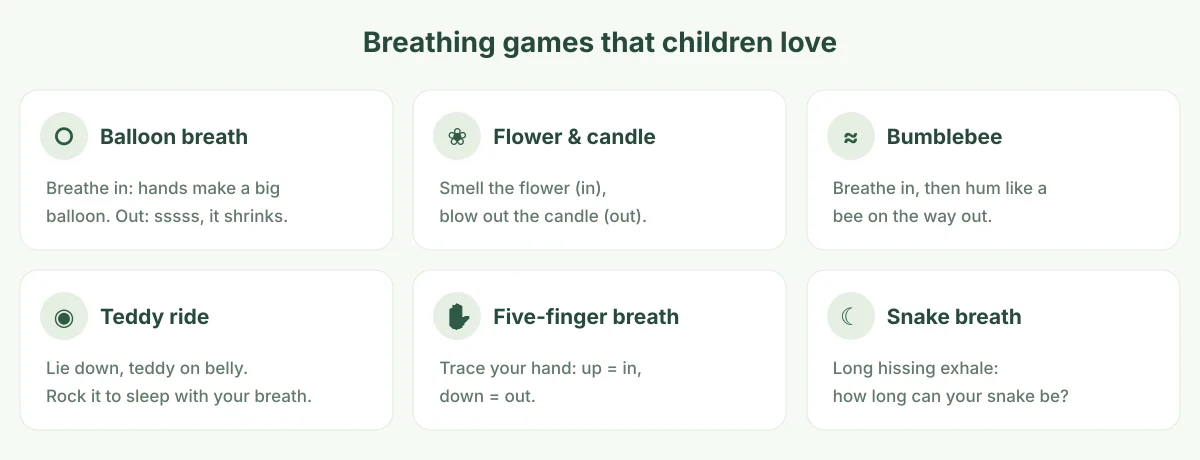
Breathing exercises help children notice their breath and calm themselves when they're excited or upset. Make them visual and playful.
For simple breathing techniques that adults can use too, see our Dutch guide to ademhalingsoefeningen bij yoga.
A ready-made 15-minute session: "A day at the farm"
- Wake up the farm (2 min). Sit in a circle. Stretch arms up like the sun rising. Do two balloon breaths.
- Morning walk (2 min). Walk around the room like different animals: big elephant steps, tiny chick steps, a galloping horse.
- The barn animals (5 min). Cat and cow on hands and knees, then dog with a wagging tail. Flap like a butterfly in the field. Hiss like a snake in the grass.
- The big tree (2 min). Stand tall as a mountain, then become a tree. The wind blows. Can your tree stay standing? Switch legs.
- Frog pond (1 min). Five frog jumps with a big "ribbit".
- Evening at the farm (3 min). Mouse pose, then lie on your back with a soft toy on your belly. Rock it to sleep with slow breaths. Quiet music or a whispered story helps. Finish by wiggling fingers and toes and sitting up slowly.
Repeat the same session for a few weeks. Young children love repetition, and they will soon start to "lead" it themselves.
Safety tips
- Use a non-slip surface and give each child enough space to stretch out arms and legs.
- Never push or pull a child deeper into a pose. Children are often very flexible; there is no need to stretch further.
- Avoid headstands, shoulder stands and long-held inversions for this age group.
- In tree pose, the foot goes above or below the knee, never on it.
- Let children stop at any time. Sitting and watching is also taking part.
- Talk to a doctor or physiotherapist first if a child has a medical condition or recent injury.
Classes or at home?
Both work. At home, yoga can be a lovely ritual before bedtime or on a rainy afternoon. A kids yoga class adds group play and a teacher who knows how to keep little ones engaged. When choosing a class, look for a teacher with specific training in children's yoga, small groups (around eight to ten children for this age), a safe space and a focus on fun rather than performance.
For babies, gentle touch is the best start; see our Dutch guide on babymassage. Parents who want their own practice can try our 15-minute home routine (in Dutch).
Parents often benefit as well: our Dutch guide to mindfulness and meditation offers a few quiet minutes of your own after the kids are in bed.
Frequently asked questions about kids yoga
At what age can children start yoga?
Playful yoga can start from around age three, often together with a parent. Classes for ages four to seven focus on animal poses, games and stories rather than technique.
How long should a yoga session for young children be?
Fifteen to thirty minutes is ideal for ages four to seven. Change activities every few minutes and always end with a short relaxation.
Is yoga safe for children?
Yes, when it's playful and children are never pushed into a stretch. Avoid headstands and shoulder stands at this age and make sure there's enough space and a non-slip surface.
Can yoga help my child calm down?
Many parents and teachers find that breathing games and short relaxations help children settle. It works best when practised regularly, not only when a child is already upset.
Do I need special equipment?
No. A non-slip mat or carpet is enough. Soft toys, scarves and a beanbag make it more fun.
This guide is general information and does not replace guidance from a qualified teacher, doctor or physiotherapist.